Why Japanese Luxury Melons Are So Expensive: Yubari Melon, Crown Melon, and Ibaraki Melons
In Japan, a melon is not always just a fruit.
Of course, there are affordable melons sold in supermarkets. Families may buy them, cut them after dinner, and enjoy them as an ordinary seasonal fruit.
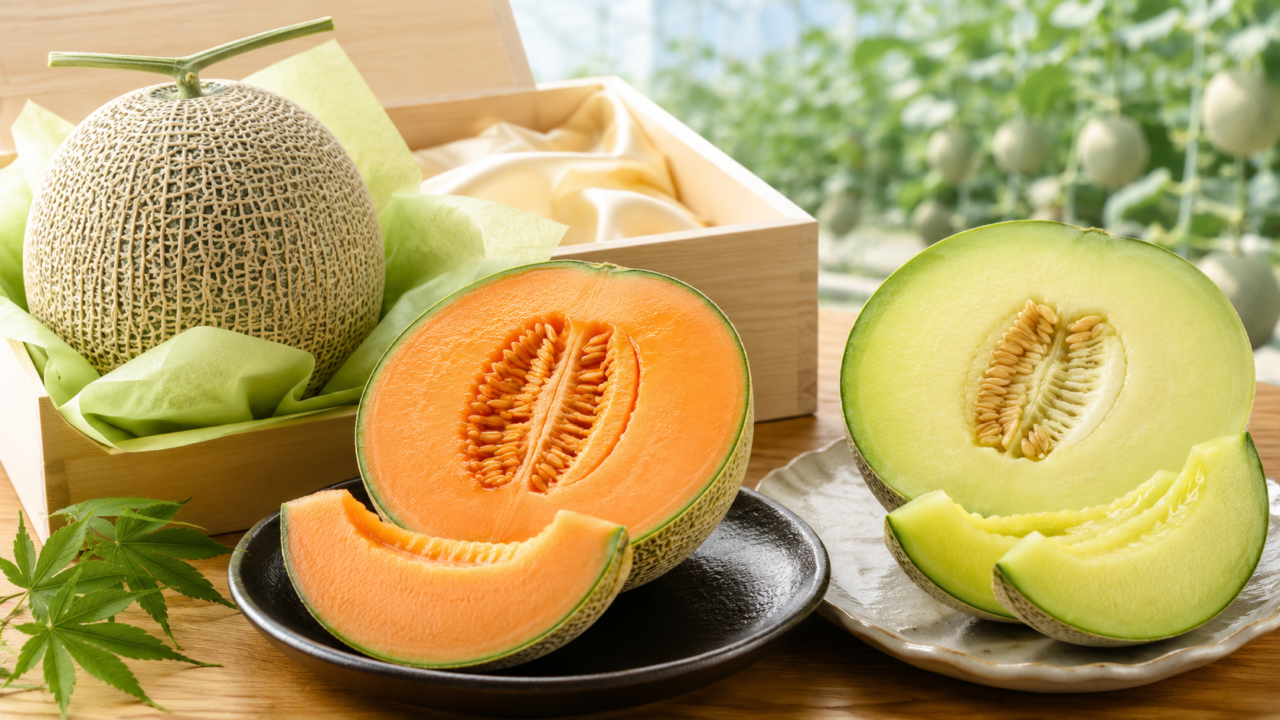
But Japan also has another kind of melon: luxury melons displayed in wooden boxes or elegant gift packaging, sold at department stores and specialist fruit shops, and treated almost like formal gifts.
Some of the best-known luxury melons in Japan include Yubari Melon from Hokkaido, Crown Melon from Shizuoka, and Ibaraking and Premium Melon from Ibaraki Prefecture.
To understand Japanese luxury melons, it is not enough to talk only about sweetness. Their value comes from a combination of cultivation techniques, greenhouse management, water control, gift culture, family celebrations, and local travel experiences.
Luxury melons are not everyday fruit, even for Japanese people
The first thing to understand is that luxury melons are not something most Japanese people eat casually every day.
Melons such as Yubari Melon and Crown Melon are special even for people living in Japan. They are not the kind of fruit that appears on the family table every week.
They are often used as gifts.
High-quality melons may be given for ochugen and oseibo, Japan’s summer and winter gift-giving seasons. They may also be given as get-well gifts, business thank-you gifts, wedding gifts, childbirth gifts, promotion gifts, or other formal presents.
A luxury melon is not valued only for its taste. Its shape, net-like skin pattern, packaging, and box all matter. It is treated as a proper, respectful gift.
Luxury melons also appear within families on special occasions: birthdays, school entrance celebrations, exam success celebrations, recovery from illness, longevity celebrations, anniversaries, or as a reward after someone has achieved something important.
In those moments, a family may say, “Let’s buy a really good melon today.”
Melon also appears in Japanese banquets and course meals. At ryokan inns, hotels, traditional restaurants, and formal dining events, a neatly cut slice of melon is sometimes served at the end of the meal.
It is not always the very highest-grade brand melon. But a ripe, beautifully cut melon gives the meal a quiet sense of elegance. It is not as flashy as cake or ice cream, but it has long been used in Japan as a refined way to finish a meal.
Japanese luxury melons are grown in greenhouses, not left to the open field
One reason Japanese luxury melons are expensive is the way they are grown.
When people overseas imagine melons, they may picture large open fields under the sun. Japan does have open-field melon cultivation. But many high-quality melons, especially those intended for gift markets or carefully graded shipment, are grown inside glass greenhouses, vinyl greenhouses, or pipe-frame greenhouses.
Shizuoka Crown Melon is famous for being grown in glass greenhouses. According to Crown Melon producers, glass greenhouses allow strong sunlight to enter, provide good air circulation through windows, and may use computer-controlled systems to manage the growing environment.
However, greenhouse and house cultivation is not limited to Shizuoka.
Ibaraki melons also have a long history of greenhouse and house cultivation. Official Ibaraki agricultural information explains that melons were once strongly associated with expensive glass greenhouse cultivation, but advances in cultivation techniques made pipe-house melon farming possible, helping melons become more widely available.
Yubari Melon cultivation also involves greenhouse planting. JA Yubari City describes a growing process that includes sowing, grafting, transplanting into greenhouses, pollination, and inspection.
In other words, high-quality Japanese melons are not fruits simply left to rain, wind, heat, and cold. Farmers create an environment in which each melon can grow in the best possible condition.
Water management determines sweetness and texture
Water management is one of the most important parts of melon cultivation.
Melons contain a lot of water, but that does not mean farmers should simply give them as much water as possible.
Too much water can damage the roots or make it harder for the fruit to develop high sugar content. Too little water can prevent the fruit from growing properly, make it smaller, and often make the flesh feel harder when eaten.
For this reason, melon farmers adjust the amount of water depending on the growth stage.
After planting, water helps the roots settle. During the fruit enlargement stage, enough water is needed to help the melon grow. When the net pattern forms and when the fruit approaches the sugar-building stage, water may be reduced.
Some Japanese cultivation guides explain that farmers increase watering during early fruit enlargement, reduce it during the hardening stage, water again to support later fruit growth and net formation, and then gradually reduce water as sugar content rises.
To manage this process, greenhouses may use sprinklers, irrigation tubes, drip irrigation, or automatic watering systems.
Such equipment helps farmers provide the right amount of water at the right time, even when rainfall is low or water conditions are difficult.
The sweetness of a Japanese luxury melon is not created simply by “reducing water.” The fruit needs water to grow. Later, water must be carefully controlled to improve sweetness, aroma, softness, and mouthfeel.
This delicate balance is one of the reasons high-quality melons require so much skill.
Shizuoka Crown Melon: one fruit per plant
Among Japan’s luxury melons, one of the most famous and expensive is Crown Melon from Shizuoka Prefecture.
Crown Melon is a premium muskmelon produced mainly in western Shizuoka, especially around Fukuroi City. It is grown inside glass greenhouses where temperature, humidity, water, sunlight, and ventilation are carefully managed.
Its most famous cultivation method is called ichiboku ikka, meaning “one tree, one fruit.”
This does not mean that the plant produces only one fruit from the beginning. Instead, several fruits may first appear. The grower selects the best one and removes the others. The nutrients from the plant are then concentrated into that single melon.
This method helps improve sweetness, aroma, smoothness of the flesh, roundness, and the beauty of the net-like skin pattern.
Crown Melons also have grades. Commonly known grades include Fuji, Yama, Shiro, and Yuki. The highest grade, Fuji, is extremely rare. Yama and Shiro are also treated as high-quality gift melons.
A Crown Melon presented in a wooden box is one of the clearest symbols of Japan’s luxury fruit culture.
Yubari Melon: the king of orange-fleshed melons
When people think of luxury melons from Hokkaido, Yubari Melon is often the first name that comes to mind.
Yubari Melon is an orange-fleshed melon produced in Yubari City, Hokkaido. The variety is called Yubari King.
It is known for its bright orange flesh, rich aroma, soft texture, and juicy sweetness. Compared with green-fleshed melons, Yubari Melon looks especially vivid when cut open.
Yubari Melon is also known for strict brand management.
According to JA Yubari City, Yubari Melons are shipped through the agricultural cooperative. Cooperative-selected melons are inspected for sugar content, net pattern, shape, size, and other qualities, and are graded into four ranks: Tokusyu, Shu, Yu, and Ryo.
This means Yubari Melon is not simply “a melon grown in Yubari.” It is a brand supported by region, variety, inspection, and quality control.
Yubari Melon is also famous for extremely high auction prices at the season’s first auction. These first-auction prices are special ceremonial or promotional prices and should not be confused with ordinary retail prices.
For travelers, Yubari Melon can be enjoyed not only at department stores and specialist fruit shops, but also during trips to Hokkaido, especially around Yubari and other melon-producing areas.
Ibaraki: Japan’s melon kingdom
Ibaraki Prefecture is one of Japan’s most important melon regions.
In fact, Ibaraki has long been Japan’s leading melon-producing prefecture. Official Ibaraki agricultural information states that the prefecture has held the top position in melon production for 27 consecutive years, from 1998 to 2024.
The strength of Ibaraki melons is variety.
The prefecture produces everything from high-end gift melons to melons that are easier for families to enjoy at home.
One of the best-known varieties is Ibaraking, an original Ibaraki variety. Its name expresses the hope that it will become “the king of Ibaraki melons.”
Ibaraking was developed over more than ten years and has a premium Earl’s-type melon as one of its parent lines. It is known for refined aroma, sweetness, smooth texture, and juicy flesh.
Another famous Ibaraki brand is Premium Melon from JA Ibaraki Asahi Village.
This brand selects melons such as Otome, Quincy, and Andes using optical sensors. Only melons with sugar content of at least 18 degrees Brix and good appearance quality are shipped as Premium Melons.
Ibaraki also produces many other melon varieties, including Otome, Andes, Quincy, Takami, and Earl’s.
Otome appears early in the spring season. Andes is known for aroma and sweetness. Quincy is a popular orange-fleshed melon. Takami keeps well and is used both for home eating and gifts. Earl’s is a fragrant, high-class melon type often associated with luxury melons.
Ibaraki melons are not only bought in large cities. They are also enjoyable at the source.
Around Hokota City and nearby areas, visitors can find melon-picking farms, direct sales shops, and places that serve melon parfaits, melon juice, melon ice cream, and melon bread.
Visiting melon-producing areas is part of the experience
Luxury melons can be purchased in major Japanese cities such as Tokyo, Osaka, and Nagoya. Department stores, specialist fruit shops, high-end supermarkets, and gift shops may sell premium melons in elegant packaging.
But for travelers, visiting the production areas can be even more interesting.
In Shizuoka, travelers can visit areas around Fukuroi City, known for Crown Melon.
In Hokkaido, Yubari, Furano, and Kyowa are famous melon-related destinations.
In Ibaraki, Hokota, Ibaraki Town, and Yachiyo are among the important melon-producing areas.
These regions often have direct sales shops, tourist farms, cafes, roadside stations, and local dessert shops. Sometimes visitors can buy fresh melons at more reasonable prices than in urban department stores.
Direct sales shops may also offer melons that are not perfect enough in appearance for formal gift use but are still delicious. A melon in a perfect box from a high-end fruit shop has its own beauty. But a melon bought close to the farm has a different kind of charm.
Melon picking is also recommended.
Visitors may enter a greenhouse, see melons growing on the plants, choose one, and harvest it. However, a freshly harvested melon is not always ready to eat immediately. Many melons need time to ripen after harvest, so visitors should listen carefully to the farm’s instructions and wait for the best eating time.
This is another interesting part of Japanese melon culture. A melon is not finished at harvest. It must be eaten at the right moment.
Melon desserts in melon-producing areas
When visiting a melon-producing area, desserts are also part of the fun.
Popular melon sweets include melon parfaits, melon juice, melon ice cream, melon shakes, and melon soft serve.
There is also melonpan, or melon bread. However, standard Japanese melonpan does not always contain real melon juice or melon flesh. In many cases, it is a sweet bread named for its melon-like shape and surface pattern.
In melon-producing areas, however, some shops sell special melonpan made with real melon juice, melon flesh, or melon cream.
For travelers who do not want to buy a whole luxury melon, desserts can be an easier way to enjoy the flavor of a famous melon region.
Check the season before you go
Melons are not available in the same way all year round.
Some melons, such as Shizuoka Crown Melon, can be shipped over a long period because of greenhouse cultivation. But melon picking, all-you-can-eat melon events, local sweets, and direct sales shop selections depend strongly on the season.
In Ibaraki, different varieties appear at different times. Otome, Ibaraking, Andes, Quincy, Takami, and Earl’s each have their own harvest and shipping periods. Official Ibaraki information explains that seasonal melons can be enjoyed from around April to October.
Hokkaido melons are strongly associated with summer. Yubari Melon, Furano Melon, and Raiden Melon each have different seasonal periods.
If your goal is melon picking or local melon desserts, always check the official information of farms, shops, or tourist facilities before visiting. Weather and growing conditions can affect the harvest schedule.
Sources and official information
- Keio University: Melon and Japanese fruit gift culture
- Official Crown Melon website
- Official Ibaraki food and agriculture portal: Melon
- JA Yubari City: About Yubari Melon
- JA Ishikawa Kahoku: Greenhouse melon cultivation guide
- Terasaka Farm: Irrigation tubes in Furano melon cultivation
- Melon Shop Maeshima: Shizuoka Crown Melon