Machi-Chuka Challenge: How to Be a Good Guest in Japan
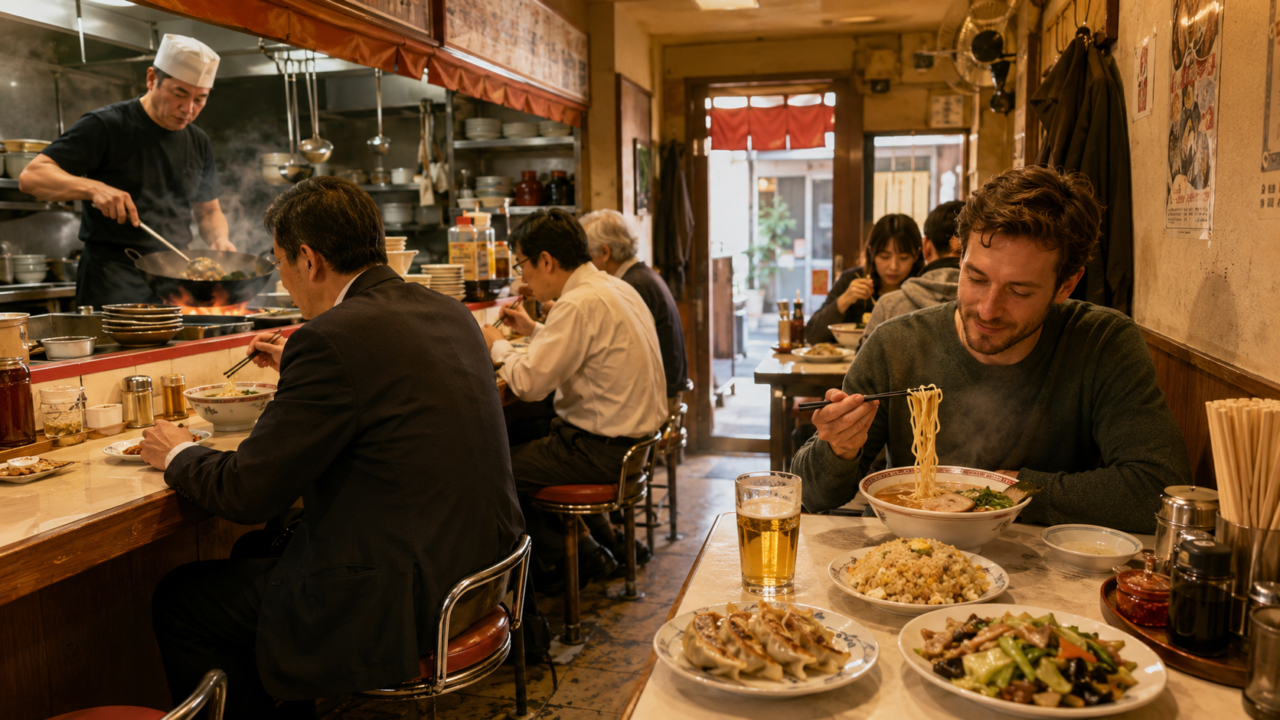
When foreign travelers search for a meal in Japan, the first options that catch their eye are usually sushi, ramen, tempura, izakaya, or convenience stores.
These are straightforward. You go to a sushi restaurant to eat sushi. You visit a ramen shop for a bowl of ramen. You head to an izakaya to enjoy drinks and small plates. Because the purpose is clear, these places are easy for travelers to choose.
However, in the neighborhoods of Japan, there exists a dining space that is a bit harder to explain.
It is called Machi-Chuka—the neighborhood Chinese diner.
What Is Machi-Chuka?
Looking only at the name, you might think it is simply a small Chinese restaurant. True, the menu features many Chinese-inspired dishes: ramen, fried rice, gyoza, mapo tofu, stir-fried pork liver with chives, sweet and sour pork, and stir-fried vegetables.
Yet, Machi-Chuka is fundamentally different from an authentic Chinese restaurant.
Machi-Chuka is a general store of food—serving Japanese, Western, and Chinese dishes—that local people use casually in their daily lives. It is not just a ramen shop, nor is it strictly a Chinese restaurant. Depending on the shop, you will find curry rice, omurice (omelet rice), katsu-don (pork cutlet bowl), oya-ko-don (chicken and egg bowl), set meals, yakisoba, chilled Chinese noodles, and half-fried rice combos.
A foreign traveler stepping inside for the first time might find it baffling.
Is this a Chinese restaurant? A ramen shop? A casual diner? Why are curry and omurice on the menu?
That confusion is actually entirely correct.
Machi-Chuka does not strictly protect a single culinary genre. It is a diner that has historically accepted whatever locals wanted to eat on any given day. Someone is eating ramen and half-fried rice for lunch. Another orders a gyoza set meal. Someone else eats stir-fried vegetables with white rice. On the way home from work, another customer enjoys a cold beer with stir-fried pork liver and chives.
Machi-Chuka is not a tourist-oriented Japanese restaurant. It is one of the most familiar dining spaces where locals satisfy their hunger, have a quick drink, and casually grab a meal in their everyday lives.
It is cheap and unpretentious. It is not a place for special anniversaries. But when you are hungry, you can always rely on it.
This “everything goes” vibe is the greatest charm of Machi-Chuka. It is a place where you do not have to limit yourself to a single dining purpose.
You Can Drink There, But It Is Not an Izakaya
There is another important feature of Machi-Chuka.
You can drink alcohol.
Most Machi-Chuka shops stock beer, chuhai (shochu cocktails), sake, and Shaoxing wine. Customers drink beer while eating gyoza, use mapo tofu as a drinking snack, or enjoy a little alcohol while filling up on fried rice or ramen.
Moreover, it can turn out cheaper than going to an izakaya.
An izakaya is a place meant for drinking, ordering several small plates, and enjoying long conversations. They often serve a mandatory appetizer (otoshi) and operate under the assumption that you will stay for a while.
On the other hand, Machi-Chuka is fundamentally a diner. You can drink, but the main character is always the food. Therefore, you can have a quick drink, eat a hearty meal, and leave promptly.
Once you understand this distinction, Machi-Chuka becomes an incredibly convenient place.
However, there is one crucial rule to remember.
Machi-Chuka serves alcohol, but it is not an izakaya.
Confusing the two can cause trouble for both the shop and the other customers.
Small Restaurants Have Their Own Rhythm
The interior of a Machi-Chuka is usually quite small. Many shops consist only of a counter and a few small tables. Some are run entirely by a single family or a very small staff.
Paying attention is especially necessary during the lunch rush.
Nearby office workers, laborers, students, local regulars, and families stream in one after another. Most of these customers are there to eat quickly during their short break. The shop staff is operating at maximum capacity—taking orders, cooking, cashiering, and guiding the next guests to their seats.
In such a confined space, drinking loudly or occupying a table for a long time disrupts the entire flow of the restaurant. Other customers lose their chance to sit.
The shop owners might not explicitly say, “You are being a nuisance.” Other customers might not give you an openly annoyed look.
But that does not mean you aren’t causing trouble.
In small Japanese shops, both owners and customers often swallow their complaints to avoid hurting others or disrupting the atmosphere. Just because you are not openly scolded does not mean you are free to do whatever you want. Rather, it is crucial to sense the situation before anyone has to say a word.
What You Need Is OMOIYARI
What you need at Machi-Chuka is not difficult etiquette.
It is OMOIYARI toward the shop and the other guests.
OMOIYARI means anticipating and visualizing the unspoken burdens of others.
You notice if the shop is getting crowded. You become aware of whether your voices are echoing through the room. If the chef looks incredibly busy, you keep your order brief. Once you finish eating, you do not occupy the seat any longer than necessary. If you drink during lunchtime, you enjoy it quietly and briefly. When it gets busy, you naturally clear out.
This is not a special set of manners. However, in small Japanese eateries, it is absolutely vital.
Become a Good Guest in Japan
Machi-Chuka is not an unfriendly place for foreigners.
In fact, the staff often shows unexpected warmth and familiarity to a “good guest.” You do not need to speak fluent Japanese. Entering quietly, ordering by pointing at the menu, keeping your group from disrupting the rhythm of the shop, enjoying the food, and saying “Gochisou-sama-deshita” (Thank you for the feast) when leaving is all it takes. Just that much can instantly soften the owner’s expression.
For a foreign traveler, Machi-Chuka might require a bit of courage at first. There might be no English menu. The staff might not speak English. The storefront might look plain and intimidating to enter.
However, Machi-Chuka is an incredible place to understand Japanese food culture.
There, you do not encounter a Japan curated for tourists, but rather the real Japan that locals eat every single day. The sheer variety of the menu reflects the unfiltered, everyday appetite of the Japanese people.
By feeling the underlying atmosphere and showing OMOIYARI, your visit becomes far more than just eating a meal. You blend into the local space, show respect, and find yourself welcomed as a good guest.
A Small Everyday Culture of Japan
This is a true adventure into the heart of small Japanese eateries.
Machi-Chuka is a microcosm of Japan’s neighborhood culture—a small, daily ecosystem where locals casually eat, have a quick drink, and keep the space alive through mutual consideration between the shop and its guests.